
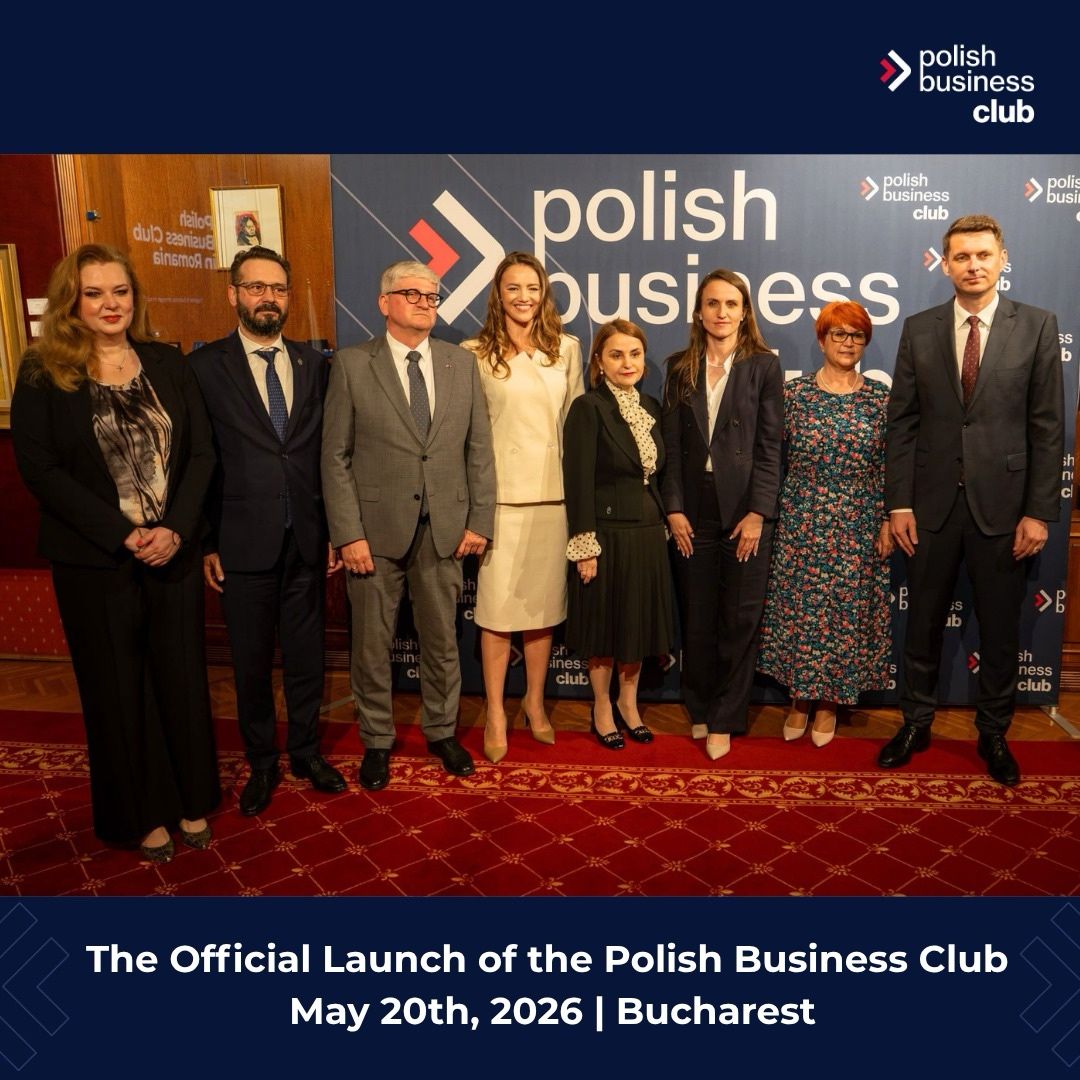
Around 200 people packed into Bucharest’s Cesianu-Racoviță Palace on May 20 for the public launch of the Polish Business Club in Romania – a mix of business leaders, Romanian officials, Polish representatives and diplomats. The club itself was quietly established back in 2025; this was its coming-out party.
Anita Izabela Imbre, the club’s founder and president, has spent more than a decade working on Polish-Romanian business ties. Her pitch for the organization is simple: give Polish and Romanian companies an actual place to meet, form partnerships, and figure out each other’s markets – and make it easier to deal with public institutions along the way.
A room full of officials
What stood out at the launch was just how much government and diplomatic firepower showed up. Mircea Abrudean, president of the Romanian Senate, was there, along with Foreign Minister Oana Țoiu, Polish Ambassador Paweł Soloch, prime ministerial adviser Luminița Odobescu, and Daniela Geanina Lazanu, a state secretary at the Ministry of Economy. Also present: Roberta Anastase, former Romanian ambassador to Poland Ovidiu Dranga, and Doru Frunzulică from the Romanian Agency for Investment and Foreign Trade.
Having both the current and a former ambassador in the room said something about how the two countries’ economic relationship has developed. Diplomats from other countries showed up too – a reminder that the club’s members aren’t only doing business within Poland and Romania, but across borders more broadly.

Not just one industry
The company list wasn’t narrow. Ebury, Brightlog, NODO Concept, Raben Group and Artmark were all publicly tied to the club’s network, alongside a mix of other Polish and Romanian businesses.
Artmark, which hosted the event, is a familiar name in Romania’s art market and has branched out into technology and investment. Brightlog, a Polish-owned company with Romanian operations, thanked the club publicly afterward for creating a space for business dialogue. NODO Concept said much the same, pointing to the opening it creates for cooperation between the two countries. The network also includes Subteno Group, a Polish legal and tax advisory firm working with mid-size and large international clients.
That spread matters. A Polish manufacturer hunting for Romanian suppliers needs something different from what a tech company or a law firm needs, but all of them are after the same basics: local contacts, market knowledge, and a way into the right institutions.
The numbers behind the launch
The club isn’t starting from zero. Bilateral trade between Poland and Romania passed €12 billion in 2025, according to figures cited at the launch and later reported by Romanian business media. Ambassador Soloch noted that Poland is Romania’s fourth-largest source of imports and sixth-largest export market. Odobescu added that trade between the two countries has tripled over the past decade. Foreign Minister Țoiu put the number of Polish companies operating in Romania at over 2,000.
So there’s already a sizeable business community straddling both markets. The real question is whether a formal club can pull more out of that relationship than would have happened anyway. For companies moving into a new country, the sticking points are usually mundane – finding trustworthy partners, making sense of local rules, tracking down suppliers or customers, knowing which office to call. That’s the gap a network like this is meant to fill.

Launch events are the easy part
Introductions and photo-ops are straightforward. What comes next is harder. The club says its job is to help members build partnerships, grow their networks, deal with public authorities, and spot opportunities in Romania. For a Polish firm eyeing the Romanian market, that could mean a local partner or the right government contact. For Romanian companies, it might mean access to Polish investors, suppliers or customers. And with so many officials already on board, the club could end up as a channel for raising problems companies run into on either side of the border – though that’s still just potential until it’s tested.
Roads, rail and defence
Several speakers pointed toward specific areas of overlap. Abrudean raised defence, infrastructure, roads and railways, naval projects, aerospace, energy security, agriculture and food production. Lazanu talked about industrial supply chains, technology transfer and partnerships between companies.
It’s a wide net, but not a random one. Poland and Romania both sit on NATO’s eastern flank, and both are involved in projects meant to knit together northern and southeastern Europe: Via Carpathia, the transport corridor linking the Baltic and Black Sea regions, and Rail-2-Sea, a related rail concept covering similar ground. Infrastructure on that scale tends to ripple outward into logistics, supply chains and where companies choose to invest – which is exactly why it matters to businesses, not just governments.
Where it goes from here
The launch gave the club visibility and a starting network of companies, officials and diplomats. That’s about all a first event can do. What will actually show whether it worked is whether companies find real partners through it, whether members expand into each other’s markets, whether new investment shows up, and whether conversations with officials turn into anything concrete. The club will also have to juggle two different audiences: businesses after practical leads, and officials and diplomats more focused on the broader economic relationship.
None of the underlying growth is the club’s doing – Polish and Romanian companies, investors and institutions have been building this relationship on their own for years. What the club adds is a dedicated platform in Bucharest to bring more of those people into the same room.
Right now, that’s the achievement: a lot of people from both business communities in one place at the same time. What comes out of the conversations they had is still to be seen.

Leave a Reply